Rafflesia Revealed
Rafflesia RevealedPosted by Kwame Johnson on 19-08-2026
Green Plant
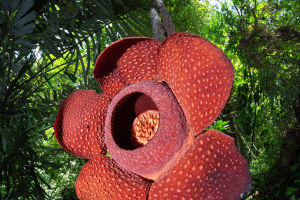
Hi Lykkers! Deep in the tropical forests of Sumatra and Borneo, Rafflesia arnoldii can appear almost like something from another world.
Its reddish-brown flower is covered with pale spots and can grow to around 1 metre across, making it the largest known individual flower.
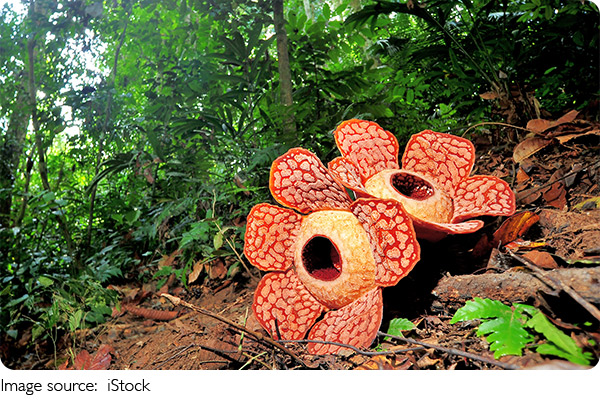
Yet its impressive size is not what gives it the nickname "corpse flower." The real reason is its powerful smell, which resembles rotting meat. For people, the odor is unpleasant. For the flower, however, it is an important reproductive tool.
Why Does Rafflesia Smell Like Dead Flesh?
The strange scent is designed to attract carrion-loving insects, particularly flies that normally search for decaying animals. When a fly enters the flower, sticky pollen can attach to its body. The insect may then carry that pollen to another flower, helping transfer genetic material between male and female blooms.
This strategy makes sense in the dense rainforest, where finding a suitable pollinator can be challenging. Instead of offering an attractive sweet fragrance, Rafflesia imitates the smell of something flies already seek.
Kew (the Royal Botanic Gardens in London) also reports that the flower can generate heat, helping its foul scent spread through the surrounding air. It is an unusual combination of smell, appearance and temperature that turns the flower into an effective signal for its intended pollinators.
The Plant Spends Most of Its Life Hidden
The most surprising part of Rafflesia may not be its enormous flower, but what happens when there is no flower at all. Unlike ordinary flowering plants, Rafflesia arnoldii has no roots, leaves, or visible stem. It is a holoparasitic plant that lives inside vines belonging to the genus Tetrastigma, a member of the grape family.
Much of the plant remains hidden within its host as delicate strands of tissue, taking in water and nutrients instead of making food through photosynthesis.
Because of this hidden lifestyle, someone could walk through its habitat without realizing that a Rafflesia is growing nearby. The plant becomes noticeable only when its developing bud pushes through the host's bark.
A Flower That Does Not Stay Around for Long
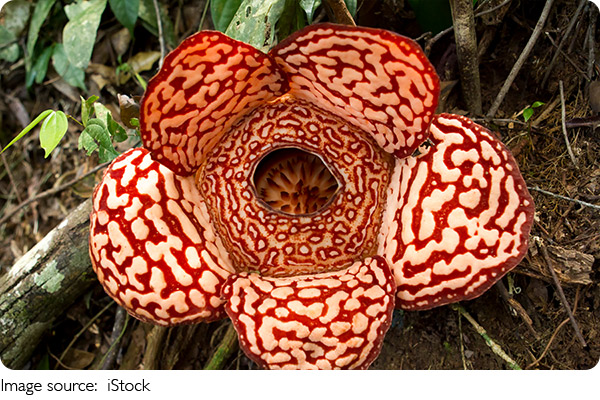
Before opening, a Rafflesia bud resembles a small cabbage-like structure. After developing, it eventually unfolds into its enormous five-lobed flower. The bloom is reddish-brown, fleshy and patterned with pale markings that contribute to its unusual appearance. The spectacular display is remarkably brief. Kew states that the flower appears for about a week, meaning that even people visiting suitable rainforest habitat may easily miss it.
Another hurdle is that Rafflesia flowers are not self-contained—each bloom carries only one role in reproduction. Successful reproduction therefore requires pollen to move between compatible flowers. Carrion flies become essential partners in this process.
Not the Same as the Titan Arum
The name "corpse flower" sometimes causes confusion because Rafflesia arnoldii is not the only plant given that nickname. Titan arum, Amorphophallus titanum, also produces a smell resembling rotting flesh. The two plants, however, are completely different. Rafflesia produces the largest individual flower, while titan arum produces a huge inflorescence, which is a structure made up of many small flowers.
That distinction matters because photographs of both plants can look spectacularly similar at first glance, while their biology is remarkably different.
Why This Strange Plant Matters
Protecting Rafflesia is complicated because saving the flower means protecting more than the visible bloom. Its survival depends on suitable rainforest habitat, its Tetrastigma host and the ecological relationships that allow the plant to reproduce. Rafflesia arnoldii has not been formally evaluated under the IUCN Red List criteria, according to Kew's species profile.
However, Kew notes that the species can be vulnerable to disturbance, including tourism and the collection of flower buds. That makes responsible ecotourism particularly important. A flower that takes so much time and such specific conditions to develop cannot simply be replaced once damaged.
Rafflesia arnoldii may look bizarre, smell terrible and spend most of its life hidden inside another plant, but every strange feature serves a purpose. Its enormous bloom provides a platform for reproduction, its rotten-meat scent attracts the right insects, and its parasitic lifestyle allows it to survive without leaves or roots.
Popular
Plants Are Shifting
Europe’s mountain summits are getting warmer, but alpine plants are not responding in one simple, predictable way.
Daylily Growing Guide
How Can We Grow Daylilies With Fuller Blooms? Try These Simple Care Tips for a Brighter, Healthier Garden!
Beginner Plant Picks
New to Plants? These 6 Easy-Growing Picks Can Help Us Create a Greener, More Beautiful Home With Less Daily Care!
Flower Art Basics
Six Easy Flower Arrangement Tricks We Can Learn Today for More Balanced and Beautiful Bouquets!