Norway’s Milky Way
Norway’s Milky WayPosted by Pardeep Singh on 27-08-2026
Holiday Topics
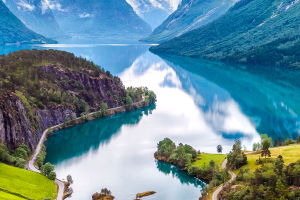
Norway’s Mjølkevegen — literally the “Milk Road” — was originally developed to connect remote mountain farms with towns and dairies below. Today, those old agricultural roads have become one of the country’s most rewarding cycling routes.
The complete journey runs for roughly 250–260 km between Vinstra and Gol, passing the edges of Jotunheimen, Norway’s highest mountain region. Expect gravel roads, turquoise lakes, summer farms, wooden inns and plenty of climbing.
You do not need to tackle the whole route. Three-day versions make an excellent long weekend, while experienced cyclists can spend six to eight days completing a much larger section.
1. Start Near Vinstra
Vinstra is a practical gateway to the northern part of the route and can be reached from Oslo by public transport.
From here, the landscape begins climbing almost immediately towards traditional mountain accommodation and high pastures.
Do not expect a gentle riverside cycle path. Even an early stage from Vinstra can involve close to 1,000 metres of ascent, depending on the exact route chosen.
That effort is rewarded quickly. Traffic becomes sparse, valleys open beneath the road and the mountains of Jotunheimen gradually appear on the horizon.
Recommendation: if you rarely ride long climbs, choose an e-bike. You will still get plenty of exercise without spending the entire holiday worrying about the next gradient.
2. Ride Beside Lake Vinstre
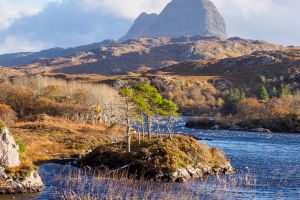
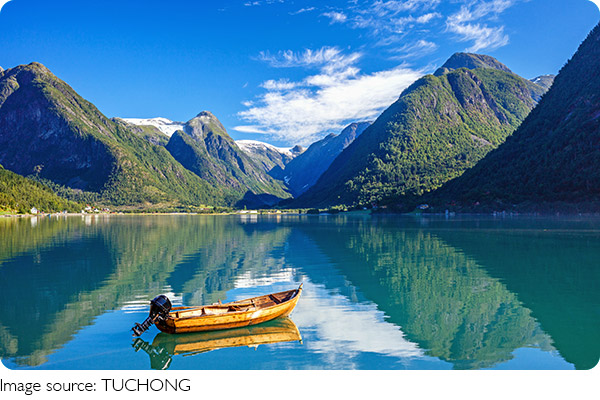
One of the most memorable stretches passes through open mountain country near Lake Vinstre.Here, gravel roads run between water and high peaks, while red and yellow wooden farm buildings dot the landscape.
Many have turf roofs, traditionally useful for insulation during harsh winters. Animals are part of the experience too. Sheep and сattle graze freely around summer farms, so riders should reduce speed when approaching them. A quiet road does not necessarily mean an empty road.
Tip: carry food even when meals are included at your accommodation. Long stretches of Mjølkevegen pass through areas with almost no shops or cafés.
Mjølkevegen
3. Cross Lake Bygdin
One of the highlights is crossing Lake Bygdin aboard the historic passenger boat M/B Bitihorn, which has operated on the lake for more than a century.
Cyclists board with their bikes and luggage before travelling between steep mountains and waterfalls towards Eidsbugarden.
Several organised cycling packages include the boat journey, removing the need to coordinate tickets separately.
Recommendation: do not treat the ferry as merely a transfer. Stay outside if conditions permit — the views from the lake offer a completely different perspective on the mountains you have just cycled through.
4. Slow Down Around Øye
The route is not only about landscapes.
Near Oye, stop to see the distinctive stave сhurch overlooking the valley. Norway has only a small number of surviving medieval stave сhurches, making these timber buildings an important part of the country’s architectural heritage.
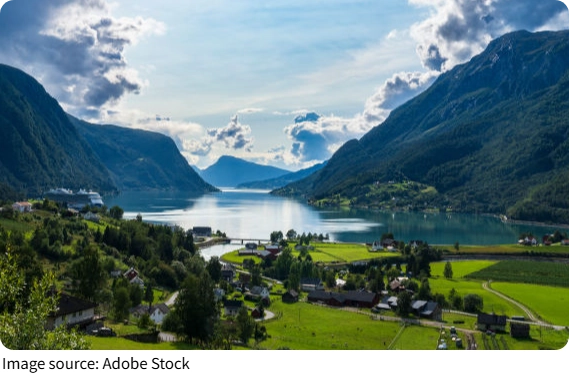
This section also passes through quieter farming communities and mountain valleys where the journey feels far removed from the better-known fjord tourist routes.
It is worth building extra time into the day instead of chasing kilometre targets.
Recommendation: plan one or two shorter stages during a longer trip. Milky Way becomes much more enjoyable when you can stop for a сhurch, farm café or mountain walk without constantly checking the clock.
5. Prepare for Slettefjell
The dramatic Slettefjell area delivers one of the route’s toughest challenges. Mountain roads here climb into exposed terrain, and weather conditions can change remarkably quickly. The original route reaches elevations of roughly 800–1,300 metres, so even a sunny summer morning can turn into wind, mist and heavy rain later in the day. Some climbs are demanding enough that experienced cyclists will appreciate low gearing.
Bring: waterproof jacket, warm layer, gloves, repair kit and enough water for several hours. Do not rely exclusively on the weather forecast. Conditions can change between valleys.
6. Stay in Mountain Inns
Accommodation is an important part of Milky Way. Instead of large resorts, much of the route relies on traditional mountain inns and small hotels where cyclists eat dinner, sleep and prepare packed lunches from the breakfast buffet.
That makes the journey surprisingly comfortable despite the remote surroundings. A current three-day self-guided northern itinerary costs around €825 per person sharing a double room. It includes two nights of accommodation, breakfast, packed lunches, dinners, luggage transfer, the lake crossing, maps and trip support. A gentler southern three-day route costs around €504 per person and covers shorter stages of roughly 36 km and 24 km.
For a full eight-day journey covering about 260 km, expect around €2,063 per person sharing, including seven nights, meals, luggage transport, transport connections and the boat trip. Bike or e-bike rental may cost extra depending on the package.
Which Route Should You Choose?
Beginners and families should consider the southern section, where gradients are gentler and daily distances shorter. Cyclists with reasonable fitness can take the three-day northern route, covering around 90 km with one particularly demanding climbing day. Experienced gravel riders can attempt a four-day fast version exceeding 200 km, while the eight-day tour is better for travelers who want to experience the landscape without racing through it.
Why Milky Way Works
The beauty of this trip is the balance between challenge and comfort.
During the day, you ride through empty highlands, past lakes and working summer farms. In the evening, there is usually a warm meal, a mountain inn and no need to carry heavy luggage between stops.
Milky Way is best approached as a journey rather than a sporting test. Take the climbs slowly, stop for waffles and lake views, and choose a route that leaves enough energy to appreciate where you are. In this part of Norway, reaching the top is satisfying — but the scenery along the way is the real reward.
Popular
Britain’s River Escapes
From paddleboarding in Yorkshire to canoeing in Scotland, these five river adventures reveal Britain from the water.
Norway’s Milky Way
Cycle quiet gravel roads between alpine lakes, mountain farms and high passes on one of Norway’s most scenic multi-day routes.
Highland Trail Escape
Walk 71 km through ancient forest, lonely glens and mountain passes on one of Scotland’s most atmospheric long-distance trails.
Sweden’s Island Summer
Kayak, island-hop and slow down among 9,000 Baltic islets on Sweden’s quieter east coast.