Terraces Against Erosion
Terraces Against ErosionPosted by Nolan O'Connor on 06-03-2026
On Trend
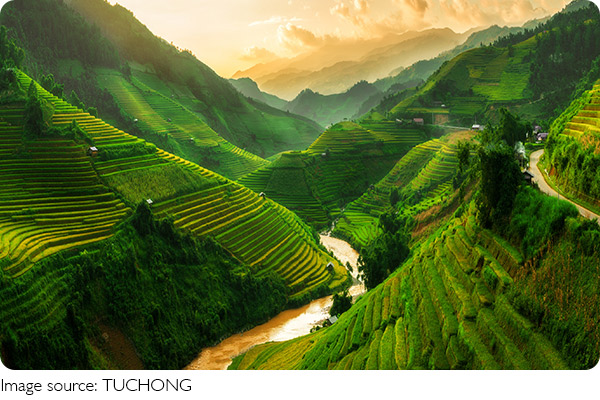
A light rain begins to fall on a steep hillside. On a bare slope, the water would quickly gather speed, rushing downhill and carrying loose soil with it.
But on a terraced hillside, the rain behaves differently. Instead of racing downward, it pauses on flat steps carved into the slope, soaking slowly into the ground.
What looks like a beautiful pattern in the landscape is also a carefully engineered system designed to protect the land itself.
For communities living in mountainous terrain, soil is both precious and fragile. Without protection, gravity and rainfall can remove fertile earth from steep slopes in a single season. Terraced farming emerged as a practical solution to this challenge, transforming difficult landscapes into stable, productive farmland.
The Structure That Slows Water
Flat surfaces reduce runoff speed
The most important feature of terraced farming is the creation of flat or gently sloped platforms. On a natural hillside, rainwater accelerates as it flows downward, gaining energy and pulling soil particles with it. Terraces interrupt this process by breaking the slope into a sequence of steps.
Each step acts like a small basin. Water slows down, spreads out, and has time to infiltrate the soil rather than washing it away. Because the slope is divided into many shorter segments, the force of runoff is dramatically reduced.
Retaining walls hold soil in place
Terraces are usually supported by walls made from stone, compacted earth, or vegetation. These retaining walls function as barriers that prevent soil from sliding downhill.
When rainfall saturates the ground, gravity can cause loose soil to shift. The walls absorb this pressure and keep the soil layer stable. Over time, plant roots also strengthen the structure by binding the soil together, creating a natural reinforcement system.
Water distribution becomes controlled
Instead of chaotic flows across a slope, terraces allow farmers to guide water deliberately. Small channels or openings can distribute water evenly from one level to another.
This controlled movement reduces sudden surges of runoff that often trigger erosion. Water is released gradually, allowing the soil on each level to absorb what it needs before the excess moves onward.
Why Terraces Protect Mountain Ecosystems
Fertile soil remains where crops grow
Topsoil is the most nutrient-rich layer of earth, containing organic matter, microorganisms, and minerals essential for plant growth. On steep slopes without terraces, this thin layer can disappear quickly during heavy rain.
Terraces act as protective containers that keep topsoil in place. By preventing erosion, they allow farmland to remain productive for generations rather than degrading after only a few planting cycles.
Sediment pollution in rivers decreases
When soil washes downhill, it does not simply vanish. It eventually settles in streams and rivers, increasing sediment levels and affecting water quality.
Terraced landscapes trap much of this soil before it leaves the hillside. Slower runoff means fewer sediments are carried into waterways, which helps maintain clearer streams and healthier aquatic environments.
Local biodiversity benefits from stable land
Terraced fields often create a mosaic of habitats. The edges of terrace walls, irrigation channels, and small patches of vegetation provide shelter for insects, amphibians, and birds.
Because the soil remains stable and moisture is retained more effectively, plants can grow along terrace edges and pathways. These micro-habitats increase ecological diversity compared with a bare eroding slope.
A Long-Term Strategy for Sustainable Farming
Land productivity improves over time
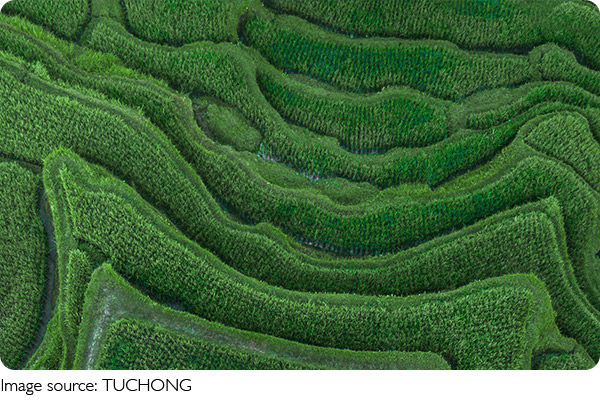
By conserving soil and moisture, terraces allow crops to grow consistently on land that would otherwise be too steep for reliable agriculture. Farmers can cultivate the same plots year after year without severe soil loss.
Water resources are used more efficiently
The step-like structure helps capture rainfall and reduce waste. Instead of quickly draining away, water remains available to plants for longer periods, which is especially important in areas with irregular rainfall.
Landscape resilience increases
Terraced hillsides are better equipped to withstand intense storms. Because runoff energy is broken into smaller flows, the risk of sudden landslides and large erosion events becomes significantly lower.
Standing on a hillside shaped by terraces, it is easy to admire the symmetry of the landscape. Yet each level represents careful observation of nature's forces. Generations of farmers learned how water moves, how soil shifts, and how small adjustments to the land could prevent loss.
The result is more than a farming technique. Terraced landscapes show how people can adapt to steep terrain while protecting the fragile layer of soil that supports life. When rain falls on those stepped hillsides, the land quietly demonstrates a lesson in patience: sometimes the best way to protect the earth is simply to slow things down.
Popular
Monument Valley Scenic Drive
A breathtaking desert road through towering red rock formations
Beautiful Waterfalls
Ten breathtaking waterfalls where nature shows its most powerful beauty
Terraces Against Erosion
How layered hillside farming protects soil and sustains mountain landscapes
Exploring Antelope Canyon
Discover the twisting sandstone corridors that glow with sunlight