How Car Engines Work
How Car Engines WorkPosted by Anika on 12-11-2026

On Trend
A turn of the key can start a car, but from the driver’s seat there’s little to show what’s happening between the fuel pump and the wheels.
Inside a gasoline engine, the same sequence repeats as long as the engine is running. Following that sequence makes it easier to see how fuel becomes motion and why airflow and timing matter.
The Four Phases
Most gasoline engines in cars use a four-phase cycle that Nikolaus Otto demonstrated in the 1870s. During intake, the piston moves down while the intake valve is open. Air enters, and fuel mixes with it either before it reaches the cylinder or inside the cylinder, depending on how the engine delivers fuel.
During compression, both valves are closed as the piston rises and squeezes the mixture. During the power phase, the spark plug ignites the mixture, and the expanding gas pushes the piston down. Finally, the exhaust valve opens and the piston moves back up, pushing the burned gas out.
Why the Piston Goes Down
The power phase is where combustion drives the piston. As the gas heats and expands, it pushes against the top of the piston. The connecting rod transfers that force to the crankshaft, which turns the piston’s up-and-down motion into rotation. A misfire happens when the mixture fails to ignite or burn properly.
Each complete cycle takes two turns of the crankshaft, with one power phase in each cylinder. At 3,000 revolutions per minute, a four-cylinder engine goes through 6,000 power phases per minute across all four cylinders.
Airflow and Engine Power
An engine can burn only as much fuel as the available air allows. A 2.0-liter engine has a total swept volume of 2.0 liters, the combined volume its pistons sweep through in the cylinders. The actual amount of air drawn in also depends on how well the cylinders fill.
A turbocharger forces more air into the cylinders. The engine’s control unit can then supply more fuel to match, so the engine can make more power without changing its displacement. If the engine takes in less air, it can burn less fuel.

Valves and Cam Timing
The crankshaft drives the camshaft through a timing belt or chain. As the camshaft turns, its raised lobes open the valves at the right points in the cycle. The camshaft turns at half the speed of the crankshaft so the valve sequence lines up with each complete cycle.
If the belt or chain slips by even a few teeth, the valves can open at the wrong time. In some engines, a piston can then hit an open valve. Variable valve timing deliberately changes when the valves open or close to suit different engine speeds.
Cooling and Lubrication
Combustion temperatures inside the cylinder can exceed 2,000 degrees Celsius. Coolant circulates through passages in the engine block and cylinder head and carries heat to the radiator, which releases it to the surrounding air.
Oil does a separate job: it lubricates parts such as the bearings, cam lobes, and cylinder walls. Going too long between oil changes can accelerate wear. If the cylinders no longer seal well, compression can drop, and the engine may idle roughly or feel less responsive when accelerating.
How Diesels Ignite Fuel
A diesel follows the same sequence, but it draws in air without fuel and does not use a spark plug to start combustion. Its compression ratio is typically around 15:1 to 20:1. Squeezing the air into a much smaller space raises its temperature enough to ignite the fuel when it’s injected.
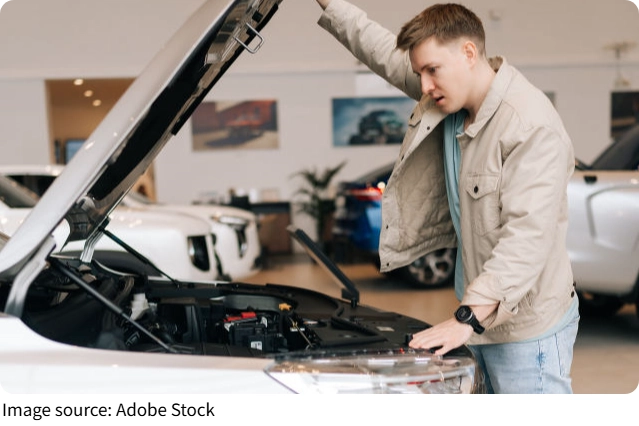
If the engine begins to idle roughly or develops a new rattle, note when it happens, such as at startup or while accelerating. That gives a technician a starting point without assuming the cause is a misfire or a worn timing chain.
Popular
Norway's EV Shift!
What does this change mean for EV drivers? Norway welcomes a new approach to fast-charging infrastructure!
Europe's Car Costs!
Why are European drivers paying more? Examine how changing car rules may affect buyers and automakers!
EU Car Ban Changes!
Could petrol cars stay beyond 2035? EU lawmakers back softer emissions targets, giving automakers room!
EV Success Cuts Into Profit
German carmakers sell more EVs than expected, but a gap between demand and profitability is emerging.