Trees That Outlive Empires
Trees That Outlive EmpiresPosted by Marcus on 10-11-2026
On Trend
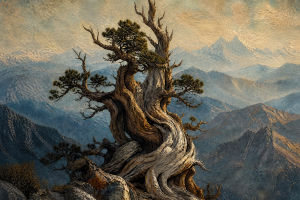
A tree does not need to tower above a forest to be ancient. Some of Earth's oldest living trees are short, twisted, and partly stripped of bark. They cling to rocky mountainsides where freezing temperatures, poor soil, and relentless winds make survival difficult.
Their ages are extraordinary, but the records come with an important distinction. A single trunk that has survived for thousands of years is not the same as a root system that continually produces new stems. Both reveal remarkable strategies for surviving environmental change.

Bristlecone Pines Hold the Record
In California's White Mountains, Great Basin bristlecone pines have survived for nearly five millennia.
One famous specimen, known as Methuselah, is more than 4,800 years old, making it one of the oldest confirmed living non-clonal trees.
It was already growing long before the Great Pyramid of Giza was completed.
These pines inhabit exposed mountain slopes, often above 3,000 metres, where thin soils, cold temperatures, and limited moisture restrict growth.
Many grow in dolomite-derived soils that are relatively poor in nutrients and support sparse vegetation.
Their annual growth rings can be exceptionally narrow, and their dense, resinous wood helps resist decay.
Scientists determine their ages primarily through dendrochronology, the study and matching of annual tree rings.
Methuselah's exact location is not publicly disclosed to help protect the tree from damage.
Old Does Not Mean Tall
A towering tree may be impressive, but height tells us surprisingly little about age.
Ancient bristlecone pines often grow slowly and develop irregular, weather-beaten shapes.
Some survive with only narrow strips of living tissue connecting their roots to their remaining branches.
Much of the exposed trunk may be dead, yet the tree continues producing new wood and needles in its surviving sections.
This pattern is sometimes called strip-bark growth.
By maintaining a smaller amount of living tissue, a tree can survive even after other parts have been damaged.
Slow growth alone does not guarantee longevity, but it is one feature of these remarkable mountain survivors.
Other Species That Reach Millennia
Bristlecone pines are not the only trees capable of extraordinary lifespans.
The alerce, or Patagonian cypress, grows in temperate rainforests of Chile and Argentina. Some individuals have been confirmed to be over 3,000 years old.
One particularly large Chilean specimen, often called Gran Abuelo, has been proposed to be more than 5,000 years old. However, that estimate relies partly on modeling rather than a complete ring count, so its exact age remains uncertain.
In Tasmania, individual Huon pines can also live for thousands of years.
A Huon pine population at Mount Read has persisted through vegetative reproduction for an estimated 10,000 years or more, but its present stems are much younger.
These examples show that exceptional longevity is not restricted to a single climate or species.
Why Harsh Conditions Can Help
It seems contradictory that difficult environments might support some of the longest-lived trees.
Yet certain stresses can reduce the threats that would otherwise shorten a tree's life.
On cold, dry mountain slopes, slow growth and limited biological activity can help preserve wood. Sparse vegetation may also reduce competition and, in some locations, the spread of destructive fires.
Bristlecone pines are particularly well adapted to these conditions.
Their dense wood, persistent resin, and ability to maintain small surviving sections help them withstand damage.
But hardship is not a universal recipe for long life.
Severe drought, fire, disease, and warming temperatures can still destroy ancient trees.
The relationship between growth rate and lifespan also varies widely among species. Some fast-growing trees live for centuries, while others die much sooner.
Clones Complicate the Count
What if a tree's trunk dies but its root system survives and produces another?
That question makes the oldest-tree record more complicated.
In Sweden's Fulufjället National Park, a Norway spruce known as Old Tjikko is associated with root material dated to approximately 9,550 years ago.
The visible trunk is much younger. Its remarkable age refers to the persistence of the organism through successive generations of stems.
A similar distinction applies to Pando, a large quaking aspen clone in Utah.
Its thousands of stems arise from a shared root system, making the grove a single clonal organism.
Individual stems generally live for decades to a little over a century, while the root system may be far older.
Pando's precise age remains uncertain, and estimates extending back many thousands of years should not be treated as firmly established measurements.
How Scientists Verify Ancient Ages
An old-looking tree is not necessarily an old tree.
Researchers often use increment borers to collect narrow wood samples, allowing them to examine growth rings without cutting down the entire trunk.
By comparing ring patterns among living and dead trees, scientists can establish reliable chronological sequences.
However, missing heartwood, irregular growth, and decay can make precise dating difficult.
Radiocarbon dating provides additional evidence, particularly for ancient wood and root material, but it does not always reveal the age of an entire living organism.
Clonal colonies present an even greater challenge because their oldest tissues may have disappeared long ago.
For that reason, scientists distinguish confirmed ages from estimates and separate the longevity of individual stems from that of connected root systems.
The oldest trees challenge our assumptions about what successful growth looks like. Some have survived for nearly 5,000 years as individual trunks, while others persist through roots that repeatedly generate new stems.
Their longevity reflects different combinations of biology, environmental conditions, and extraordinary resilience. Harsh surroundings can sometimes protect a tree from competition and decay, but they also expose it to serious risks.
Perhaps the most striking lesson is that a tree's appearance reveals very little about its history. A small, weathered pine may have been alive while entire civilizations rose and disappeared.
Popular
Amazon Cacao Growth!
Can cacao farms grow without clearing forests? New mapping reveals a different path in Brazil!
Heat Tests Giant Redwoods
California’s tallest trees can survive extreme heat, but new research shows their photosynthesis begins to falter surprisingly early.
Why Your Cactus Won't Bloom
Light, cold winters, and the right container size decide whether your cactus ever flowers.
Why Lilies Float
Water lilies don't fight the water, they use it. Here's the quiet engineering behind those floating blooms.