Trees That Drink the Sea
Trees That Drink the SeaPosted by Chandan Singh on 10-11-2026
On Trend
Hi, let's get started. Most trees would be dead within a week if you planted them in salt water.
Mangroves don't just survive there, they build entire forests along tropical coastlines from the Florida Keys to the Sundarbans in Bangladesh. The trick isn't one single adaptation, it's a stacked set of them working together.
Salt gets blocked at the root
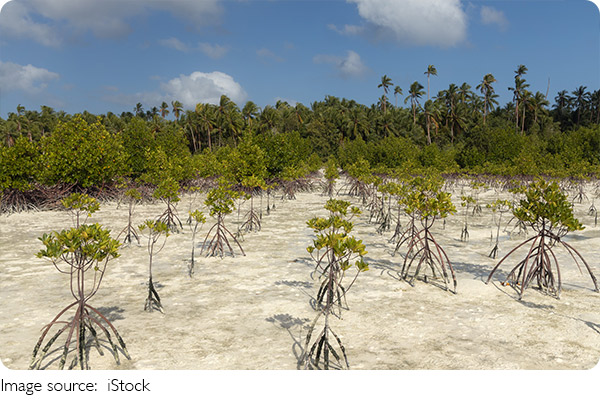
Red mangroves, the ones with those stilt-like prop roots you see hanging over the waterline, use a filtration mechanism at the root surface. The root tissue contains suberin, a waxy substance that repels water and dissolved salts, so the plant takes in mostly fresh water even when it's sitting in brine. It's not perfect, and some salt still slips through, which is why the next step matters.
What leaks in gets expelled
Black mangroves take a different route. They absorb the salty water but push the excess salt out through special glands on their leaves, which is why the leaf surfaces often look crusted with white crystals. You can literally see the salt on the foliage if you look closely at a black mangrove stand in southern Florida. Some species also concentrate salt in older leaves and then drop them, dumping the load before it damages the rest of the tree.
Breathing through thin air
Waterlogged mud holds almost no oxygen, so mangrove roots would suffocate without help. Enter pneumatophores, the pencil-shaped spikes that black mangroves send up from the soil around the trunk. These structures are packed with tiny pores called lenticels that let air in, and the oxygen travels down to the buried roots. Walk through a black mangrove flat at low tide and you'll see thousands of them sticking up like a field of straws.
The tide does the watering
Mangroves don't need rain to stay hydrated, they let the tide do the work. Twice a day the rising water brings in nutrients and carries away waste, and the trees have tuned their internal water pressure to cope with the constant shift. That's a big part of why they cluster in the intertidal zone, where the water level moves predictably rather than sitting still.
Wet feet, dry seeds
Most seeds drown or rot in salt water. Mangrove seeds don't. Many species are viviparous, meaning the seed germinates while still attached to the parent tree, and the resulting propagule is a long, heavy pod that can float for weeks before lodging in mud. Some, like the red mangrove's cigar-shaped propagule, drop straight down and spear into the sediment, ready to root within days.

Put those four systems together and you get a plant that filters salt, expels what gets through, breathes through aerial roots, and uses the tide as its water supply. That's why mangrove forests line so many tropical coasts, and why they hold up the shoreline while they're at it. Next time you see those roots poking out of the water, remember you're looking at a tree that solved four problems at once.
Popular
Amazon Cacao Growth!
Can cacao farms grow without clearing forests? New mapping reveals a different path in Brazil!
Heat Tests Giant Redwoods
California’s tallest trees can survive extreme heat, but new research shows their photosynthesis begins to falter surprisingly early.
Why Your Cactus Won't Bloom
Light, cold winters, and the right container size decide whether your cactus ever flowers.
Why Lilies Float
Water lilies don't fight the water, they use it. Here's the quiet engineering behind those floating blooms.