Check Blood Pressure at Home
Check Blood Pressure at HomePosted by Mukesh Kumar on 16-09-2026
Healthy Life
Home blood pressure monitoring can provide a useful picture of how your blood pressure changes over time.
When measurements are taken correctly and recorded consistently, they can help your healthcare professional assess your readings between appointments.
Reliable monitoring starts with proper preparation, correct positioning, and a well-fitting cuff.
Why Monitor Blood Pressure at Home?
“Measuring your blood pressure at home is simple and effective.” — National Heart, Lung, and Blood Institute.
Home monitoring can help determine whether your readings remain within the range recommended for you. Repeated measurements can also reveal patterns that may not be apparent from an occasional clinic reading.
For people receiving treatment for hypertension, a record of home measurements can help healthcare professionals evaluate how well the treatment plan is working.
Prepare Before Measuring
For a reliable reading, sit quietly for at least five minutes before measuring. Avoid exercise and caffeine shortly beforehand because they can temporarily affect blood pressure.
Before starting:
- Empty your bladder.
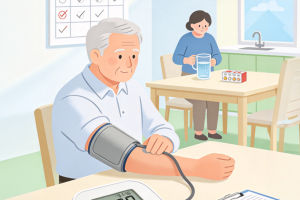
- Sit with your back supported.
- Keep both feet flat on the floor.
- Keep your legs uncrossed.
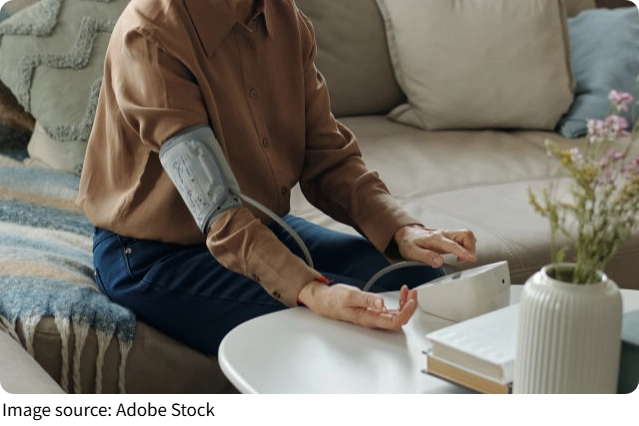
- Rest your arm on a table with the cuff at approximately heart level.
- Place the cuff directly on your bare upper arm.
Make sure the cuff is the correct size for your arm. An improperly sized cuff can affect measurement accuracy.
Follow the Correct Measurement Technique
Position the cuff according to the monitor's instructions. Sit comfortably and remain still and silent while the measurement is taken.
Keep your arm relaxed and supported, with your hand resting comfortably. After the first reading, wait about one minute before taking a second measurement.
Record both results with the date and time, unless your healthcare professional has provided a different monitoring schedule.

Understand Systolic and Diastolic Pressure
A blood pressure reading contains two values, measured in millimeters of mercury (mmHg).
Systolic pressure is the upper number. It reflects the pressure in the arteries when the heart contracts.
Diastolic pressure is the lower number. It reflects the pressure in the arteries when the heart relaxes between beats.
For example, a reading of 120/80 mmHg has a systolic pressure of 120 and a diastolic pressure of 80.
How to Interpret Your Reading
For many people, a reading below 120/80 mmHg is within the normal range. However, blood pressure categories can differ among clinical guidelines, so your personal target should be based on advice from your healthcare professional.
A single measurement does not necessarily represent your usual blood pressure. Reviewing multiple readings provides a more useful picture.
If your measurements are consistently above your recommended range, share your record with your healthcare professional.
Avoid Measurement Errors
Several common habits can interfere with an accurate reading:
- Measuring immediately after exercise
- Talking during the measurement
- Moving while the monitor is operating
- Crossing your legs
- Leaving your arm unsupported
- Placing the cuff over clothing
- Using the wrong cuff size
- Measuring while rushed
Following the same preparation and positioning routine each time helps produce more comparable results.
When to Seek Urgent Medical Care
If your blood pressure is higher than 180/120 mmHg, wait at least one minute and take another measurement. If it remains this high, contact a healthcare professional promptly for guidance.
If a reading above this level occurs with symptoms such as chest pain, severe shortness of breath, weakness, numbness, difficulty speaking, confusion, or vision changes, seek emergency medical care immediately.
How Often Should You Measure?
Your monitoring schedule depends on your health needs and your healthcare professional's recommendations. Some people may be asked to measure twice daily for a specific period, while others may need less frequent checks.
When regular monitoring is recommended, take measurements at consistent times and maintain a written or digital record. This makes it easier to identify changes and discuss them during healthcare appointments.
Make Home Monitoring Reliable
Effective home monitoring depends on proper preparation, accurate technique, and consistent record-keeping. Taking measurements correctly is more valuable than checking repeatedly without a clear plan.
If your readings repeatedly fall outside your recommended range, discuss them with your healthcare professional. Do not change prescribed medication or treatment based solely on home readings.
Popular
Gut Microbes And Women
Small-bowel bacteria differ between women and men, offering new clues to conditions that disproportionately affect women.
Path To Riches
Why Millionaires Think Completely Differently About Money and Success!
Smarter Business Finance
Small Businesses Are Exploding in Growth Thanks to This Financial Technology!
Diabetes Checkups Explained
What to Know About Blood Sugar Testing, Glucose Monitoring, and Doctor Visits