The Harvest-Day Clock
The Harvest-Day ClockPosted by Yuna on 08-09-2026
Useful Tips
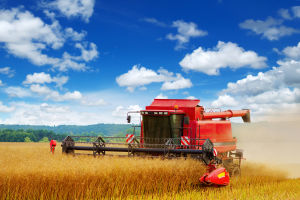
A combine may spend hours working across the same field, yet harvesting conditions can change considerably from morning to evening.
Dew can make straw tough, the afternoon sun can dry the crop, wind can increase shattering, and even a small change in grain moisture can affect storage or drying decisions.
Speed Has an Invisible Cost
A combine covering more ground per hour may look more productive, but the fastest ground speed is not necessarily the fastest way to finish the field.
Watch what exits the machine
Grain can be lost before entering the header, at the header itself, or during threshing and separation. If losses increase as travel speed rises, those extra hectares per hour may simply mean more grain is being left on the ground.
That is why operators periodically stop and inspect the area behind the combine.
Seeing grain on the ground does not automatically mean the combine is responsible for the loss. Some kernels may already have been there before the machine arrived.
Compare three places: an unharvested area, the area in front of the combine, and the area behind the combine. The differences can help indicate whether losses are occurring before harvesting, at the header, or farther through the machine.
Small checks can change the rest of the day
Imagine a combine has four hours of workable conditions left. Increasing ground speed by 10% might appear to give roughly 10% more field coverage.
But if the faster setting noticeably increases header or separator losses, the calculation changes. More acres completed does not automatically mean more grain collected.
The Grain Tank Sets Another Clock
The combine is only one part of harvest. Once the grain tank fills, the rest of the operation has to keep up.
Unloading can control field capacity
Suppose a combine fills its grain tank every 15 minutes but waits five minutes each time for transport. Over four hours, those repeated five-minute waits could add up to roughly an hour of lost harvesting time.
That is why grain carts or transport vehicles often work alongside the combine rather than arriving only after the tank is completely full.
The real bottleneck may be the road, storage site, unloading point, or lack of available transport vehicles rather than the combine itself.
Field shape changes harvest time
Two fields of equal area can take very different amounts of time to harvest.
A long, rectangular field allows the combine to make longer harvesting passes. A smaller, irregular field may require frequent turns, repositioning, and short passes around boundaries.
If a machine spends 20 seconds turning at the end of each pass, 60 turns add up to 20 minutes when the header is not harvesting.
That is why route planning inside the field matters. Operators can save time by deciding where to start, how transport vehicles will move through the field, and how to reduce unnecessary turning.
Afternoon Can Be the Sweet Spot
Conditions often become easier as dew disappears and the crop dries, but later is not always better.
Drier crops may feed differently
As the crop dries through the day, threshing can become easier and travel speed may increase. At the same time, very dry heads or pods can make some crops more prone to grain loss at the header.
That means the combine may need different settings at 5 p.m. than it did at noon.
Harvest settings are not always a “set it and forget it” decision. Ground speed, reel position, rotor or cylinder speed, concave clearance, fan settings, and sieves may all need adjustment as crop conditions change.
Recheck after a major change in conditions
Whenever the crop starts behaving differently, it is worth checking the combine again. For example, this may happen when morning dew has fully disappeared, the combine moves into a visibly drier section, wind increases, grain moisture changes, or travel speed has been raised.
Each change can affect losses or grain quality, even though the machine is still harvesting the same crop in the same field.
A harvest day runs on several clocks at once: crop moisture, dew, machine losses, grain-tank capacity, transport timing, field layout, and changing afternoon conditions. None of these factors works independently. A faster combine can effectively become slower if trucks cannot keep up, while waiting for surface moisture to disappear may lead to several more productive hours later in the day.
Popular
A Less Dusty Home
Dust seems to return almost as soon as it is removed, but a few changes to your home can make a noticeable difference.
Love And Companionship
Is Love or Companionship More Important? The Surprising Truth About What Keeps Relationships Strong Over Time!
A Cleaner, Calmer Home
Pro housekeepers share easy cleaning habits – fresh bedding, clear floors, smarter decluttering.
Wellness Without Pressure
A healthier routine does not need a complete life overhaul. Small habits around sleep, movement and stress can make a real difference.