Smooth Oil Care
Smooth Oil CarePosted by Declan Kennedy on 25-05-2026

Useful Tips
Hey Lykkers and friends, when we take care of a vehicle, one simple question often appears: should engine oil be changed based on time or mileage? Different drivers may give different answers, which can make the topic confusing.
In reality, there is no single fixed rule that fits every situation. Engine oil works continuously inside the engine, helping reduce friction, control temperature, and keep internal parts clean. To maintain stable performance, we need to understand how oil changes over time and usage, and then apply a balanced approach.
Let’s break it down in a clear and practical way that works for everyday driving conditions around the world.
Understanding Different Oil Types
We first need to look at the type of engine oil being used, because this directly affects the service interval.
- Conventional mineral-based oil is usually the most basic option. It is commonly suitable for shorter usage cycles, generally around 5,000 kilometers or about 6 months, depending on which comes first.
- A blended semi-synthetic option provides improved stability. It typically supports around 7,500 kilometers or roughly 8 months of use.
- Fully synthetic oil offers the highest level of protection and durability. In many modern vehicles, it can last up to around 10,000 kilometers or close to 12 months.
These differences show that oil quality strongly influences maintenance timing. Higher-grade oil usually allows more flexible scheduling.
Driving Environment Plays a Big Role
Beyond oil type, real-world driving conditions also matter a lot.
- If we often drive short distances, the engine may not fully reach its optimal operating temperature. In such cases, moisture and fuel residue can gradually accumulate inside the oil, reducing its effectiveness faster than expected.
- Urban traffic with frequent stops and slow movement can also place extra load on engine lubrication. Even when mileage is not high, oil performance may still decline over time.
- On the other hand, steady long-distance driving usually allows the engine to operate more consistently, helping the oil maintain stable performance for a longer period.
Because of these differences, we should always consider how the vehicle is actually used, not just the odometer reading.
Why Time and Mileage Should Work Together
Most modern vehicle guidelines already combine both time and mileage as reference points.
For example, even if a vehicle has not reached 5,000 kilometers, conventional oil should still be replaced once it passes several months of use. Similarly, synthetic oil should not be kept indefinitely, even if driving distance is low.
This is because engine oil naturally ages over time. Additives inside the oil gradually lose strength, and exposure to oxygen and moisture can slowly reduce lubrication quality.
So even when a vehicle is parked more often than driven, the oil still changes in condition inside the engine system.
Special Situations That Need Extra Attention
There are a few driving situations where oil maintenance becomes even more important.
- For a new vehicle, the first oil change is often done earlier than usual. This helps remove tiny particles created during the initial running phase of the engine. It is commonly scheduled around the early mileage stage, depending on manufacturer guidance.
- For turbocharged engines, working temperatures are generally higher. This can speed up oil aging, so shorter intervals are often recommended, such as within 7,500 kilometers.
- If a vehicle is not used for a long period, oil can still degrade naturally over time. In such cases, replacing it within several months to about a year is often considered a reasonable approach, even without high mileage.
Simple Ways to Observe Oil Condition
Besides following general schedules, we can also pay attention to visible signs of oil condition.
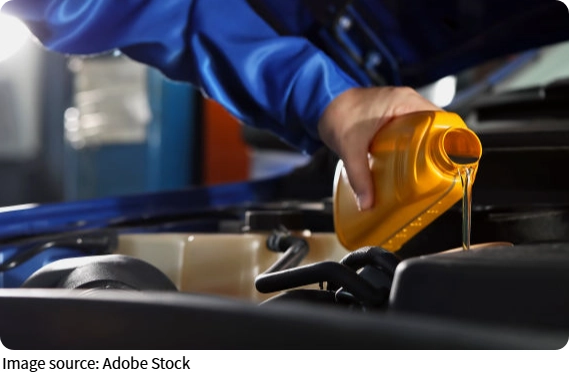
- Fresh oil usually has a clear amber tone. As it ages, it gradually becomes darker and thicker due to accumulated particles and heat exposure.
- Using a dipstick, we can also feel texture changes. If the oil becomes too thin or uneven, it may indicate reduced performance.
- Another practical method is using an oil testing paper. A normal drop spreads evenly with clear rings, while irregular or blurred edges may suggest that the oil has lost stability.
- In addition, driving feedback can provide clues. If the engine sounds slightly rougher or feels less responsive during acceleration, it may be worth checking oil condition.
Putting Everything into Perspective
When we combine all these factors, it becomes clear that engine oil maintenance is not a one-size-fits-all rule.
The best approach depends on oil type, driving habits, climate conditions, and how frequently the vehicle is used. A balanced understanding helps us avoid both early replacement and overly delayed changes.
By combining time-based and mileage-based thinking, we can better protect engine performance and maintain smoother operation over the long term.
Closing: A Smarter Way to Care for Our Cars
Lykkers, vehicle care becomes much easier when we understand the logic behind it instead of relying on a single fixed number.
Next time we think about oil replacement, we can consider both distance and time together, observe oil condition, and adjust based on real driving habits.
What kind of driving pattern do we usually have—short daily trips or longer steady journeys? Reflecting on this can help us build a more suitable maintenance routine and keep our vehicles running smoothly for years to come.

There is no single rule for engine oil changes. The right interval depends on oil type, driving environment, and time elapsed – not just kilometers traveled. Conventional oil may need replacement every 5,000 km or 6 months, while synthetic oil can often last 10,000 km or 12 months. Always check oil color and texture using a dipstick.
For short trips or turbocharged engines, change oil earlier. By balancing mileage and calendar time, you will extend engine life and avoid costly repairs. When in doubt, consult your vehicle owner's manual.
Popular
Clear View Drive
Why Does Your Windshield Fog Up on Rainy Days? Try These Simple Tricks for Instant Clarity While Driving!
Motorcycle Brake Check
Most Riders Skip This One Step — And It's the Reason Brakes Fail Without Warning
Motorcycle Cleaning Guide
Motorcycle After Rain: How to Clean, Dry, and Protect Your Bike From Corrosion
GPS Map Updates Explained
How modern navigation systems update maps wirelessly and pull real-time traffic from millions of drivers.